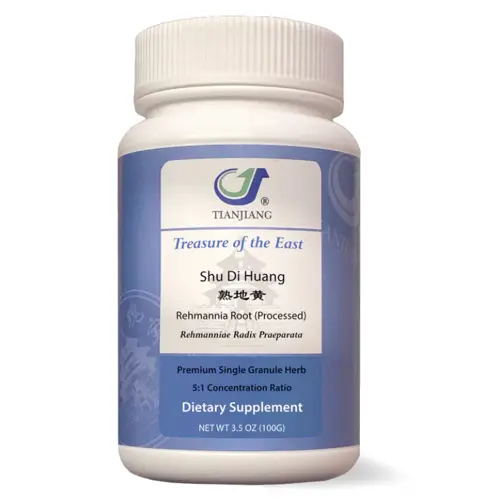
About This Herb*
Traditional Chinese Medicine background and properties
Herb Description*
Prepared Rehmannia root is one of the most important blood-nourishing herbs in Chinese medicine. Created by repeatedly steaming and drying the raw Rehmannia root, it becomes a rich, sweet tonic that replenishes blood and deeply nourishes the body's vital reserves. It is commonly used for symptoms related to blood deficiency and kidney weakness, such as fatigue, dizziness, menstrual irregularity, lower back soreness, and premature greying of hair.
Herb Category*
Main Actions*
- Nourishes Blood
- Nourishes Yin
- Benefits Essence and Fills the Marrow
- Supplements the Liver and Kidneys
How These Actions Work*
'Tonifies Blood' means Shu Di Huang replenishes the body's blood supply. In TCM, blood is responsible for nourishing and moistening the tissues, maintaining healthy complexion, and supporting clear thinking. When blood is deficient, a person may look pale or sallow, feel dizzy, experience palpitations, or have scanty or irregular periods. Shu Di Huang is considered the primary herb for addressing blood deficiency and is the lead ingredient in Si Wu Tang (Four Substances Decoction), the foundational blood-tonifying formula.
'Nourishes Yin' refers to replenishing the body's cooling, moistening, and substantive reserves. Yin deficiency shows up as dryness, night sweats, hot flashes, a dry mouth and throat, and a feeling of heat in the palms and soles. Because Shu Di Huang enters the Liver and Kidney channels and has a rich, sweet, and slightly warm nature, it deeply nourishes the Yin of these organs without the cold nature that raw Rehmannia (Sheng Di Huang) carries.
'Benefits Essence (Jing) and fills the marrow' means this herb supports the body's deepest constitutional reserves. In TCM, Essence is stored in the Kidneys and governs growth, reproduction, brain function, and bone strength. When Essence is depleted, symptoms such as premature greying, weak knees and lower back, poor memory, reduced fertility, and slow development in children may appear. Shu Di Huang's heavy, dense, sticky quality allows it to sink deeply to replenish these fundamental reserves.
'Supplements the Liver and Kidneys' reflects the herb's channel affinity. The Liver stores blood and the Kidneys store Essence. When both organs are depleted, symptoms may include blurred vision, tinnitus, dizziness, lower back weakness, and menstrual disorders. Shu Di Huang addresses the root cause by nourishing both Liver blood and Kidney Yin simultaneously.
Patterns Addressed*
In TCM, symptoms cluster into recognizable patterns of disharmony that reveal what's out of balance in the body. Shu Di Huang is traditionally associated with these specific patterns.
The following describes this herb's classification within Traditional Chinese Medicine theory and is provided for educational purposes only.
Why Shu Di Huang addresses this pattern
Shu Di Huang is the foremost herb for blood deficiency. Its sweet taste and slightly warm nature directly tonify and generate blood, entering the Liver channel where blood is stored. Its rich, dense quality provides the substantial material the body needs to replenish depleted blood. Unlike herbs that simply move or invigorate blood, Shu Di Huang acts as a building block, supplying deep nourishment that addresses the root of blood deficiency.
A practitioner would look for one or more of these signs
Sallow or pallid face from insufficient blood nourishing the skin
Dizziness from blood failing to nourish the head
Palpitations from the Heart lacking blood nourishment
Scanty or irregular periods from insufficient blood to fill the Chong vessel
Poor sleep due to blood failing to anchor the spirit
Why Shu Di Huang addresses this pattern
Shu Di Huang is the primary herb for nourishing Kidney Yin. It enters the Kidney channel and its heavy, sweet, sticky quality allows it to sink to the lower body and deeply replenish the Kidney's Yin reserves. When Kidney Yin is depleted, the body loses its cooling and moistening capacity, producing signs of deficiency heat. Shu Di Huang addresses this by directly filling the Kidney's Yin and Essence, which is why it serves as the King herb in Liu Wei Di Huang Wan, the foundational Kidney Yin formula.
A practitioner would look for one or more of these signs
Soreness and weakness in the lower back and knees
Night sweats from Yin failing to contain Yang at night
Ringing in the ears from Kidney Essence failing to nourish the ears
Tidal heat sensations, especially in the afternoon
Early greying or hair loss from depleted Kidney Essence
Why Shu Di Huang addresses this pattern
Shu Di Huang simultaneously nourishes both Liver blood and Kidney Yin, making it uniquely suited for this combined pattern. The Liver and Kidney share a common origin: the Kidney stores Essence and the Liver stores blood, and the two nourish each other. When both are depleted, symptoms combine Liver blood deficiency (blurred vision, dry eyes, dizziness) with Kidney Yin deficiency (weak lower back, tinnitus, reduced fertility). Shu Di Huang's dual channel entry allows it to replenish both organs from a single source.
A practitioner would look for one or more of these signs
Blurred or declining vision from Liver blood failing to nourish the eyes
Dizziness and lightheadedness from combined Liver-Kidney depletion
Weak knees and lower back
Tinnitus or hearing loss
Why Shu Di Huang addresses this pattern
Kidney Essence governs growth, development, reproduction, and aging. Shu Di Huang's action of 'filling the marrow and benefiting Essence' directly addresses this pattern. Its dense, heavy nature mirrors the substantial quality of Essence itself. This is why Shu Di Huang appears in formulas like Zuo Gui Wan, which uses pure supplementation without draining to maximally replenish depleted Essence in cases of severe constitutional weakness.
A practitioner would look for one or more of these signs
Reduced fertility from depleted reproductive Essence
Premature greying or hair loss
Poor memory and concentration from Essence failing to fill the brain
Chronic weakness in the lower back and knees
TCM Properties*
Slightly Warm
Sweet (甘 gān)
Tuber (块茎 kuài jīng / 块根 kuài gēn)
This is partial information on the herb's TCM properties. More detailed information is available on the herb's dedicated page
*These statements have not been evaluated by the Food and Drug Administration. This product is not intended to diagnose, treat, cure, or prevent any disease.