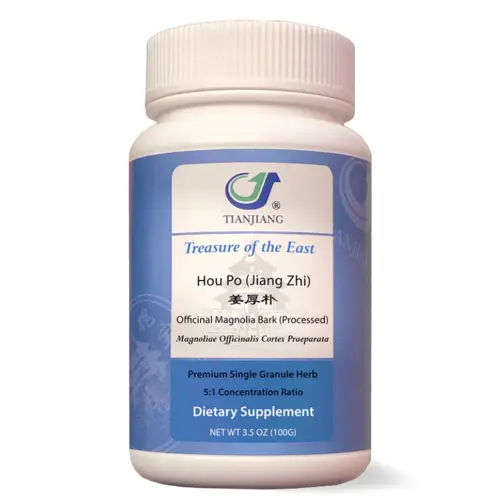
About This Herb*
Traditional Chinese Medicine background and properties
Herb Description*
Magnolia bark is a widely used herb in Chinese medicine known for relieving bloating, abdominal fullness, and digestive discomfort. Its warm, bitter, and pungent nature helps dry excess moisture in the body, move stagnant Qi, and ease coughing with thick phlegm. It is considered the premier herb for any condition involving distension and uncomfortable fullness in the abdomen or chest.
Herb Category*
Main Actions*
- Dries Dampness and Transforms Phlegm
- Descends Qi and Relieves Distension
- Moves Qi and Resolves Stagnation
- Calms Wheezing
How These Actions Work*
'Dries Dampness and resolves Phlegm' means Hòu Pò uses its bitter, warm, and drying nature to clear excess moisture that has built up in the digestive system or lungs. When Dampness accumulates in the Spleen and Stomach, it causes a heavy, bloated sensation, nausea, loose stools, and a thick greasy tongue coating. This herb's bitter taste drains the Dampness downward, and its pungent taste helps scatter it, restoring the Spleen's ability to transform and transport fluids properly. In the lungs, this same action helps dissolve thick, sticky Phlegm that causes chest tightness and coughing.
'Descends Qi and relieves fullness' means Hòu Pò has a powerful downward-directing action on the body's Qi. When Qi gets stuck and stops flowing normally in the abdomen, the result is distension, bloating, and a feeling of uncomfortable fullness. Hòu Pò pushes this stagnant Qi downward and outward, actively relieving that bloated, stuffed feeling. Classical texts describe it as the foremost herb for relieving distension and fullness (消胀除满之要药). It applies to any kind of abdominal or chest fullness, whether caused by Dampness, food stagnation, or Qi blockage.
'Moves Qi and resolves stagnation' refers to the herb's ability to break up congestion caused by food or waste that has accumulated in the digestive tract. When food sits undigested and blocks the intestines, causing constipation with bloating and abdominal pain, Hòu Pò moves the Qi to help push things along. It is commonly paired with purgative herbs like Dà Huáng (rhubarb) to treat constipation with abdominal fullness.
'Calms wheezing' describes how Hòu Pò helps when thick Phlegm blocks the lungs and the Lung Qi rebels upward, causing coughing and wheezing. By drying the Phlegm and directing Qi downward, it opens the chest and eases breathing. This is especially relevant when the wheezing is accompanied by a feeling of chest oppression and copious sticky sputum.
Patterns Addressed*
In TCM, symptoms cluster into recognizable patterns of disharmony that reveal what's out of balance in the body. Hou Po is traditionally associated with these specific patterns.
The following describes this herb's classification within Traditional Chinese Medicine theory and is provided for educational purposes only.
Why Hou Po addresses this pattern
When Dampness accumulates in the middle burner (Spleen and Stomach), it impairs the Spleen's ability to transform and transport, causing a heavy, waterlogged sensation in the abdomen with bloating, nausea, and loose stools. Hòu Pò is ideally suited to this pattern because its bitter taste dries Dampness, its warm temperature counters the cold, heavy nature of Dampness, and its pungent taste scatters and mobilizes the stuck Qi that always accompanies Dampness. It enters the Spleen, Stomach, and Large Intestine channels directly, targeting the middle and lower digestive tract where this pattern manifests. This is why Hòu Pò is described as the essential herb for eliminating fullness and distension.
A practitioner would look for one or more of these signs
Heavy, distended feeling in the upper abdomen
Nausea or vomiting with no appetite
Loose stools or diarrhea with undigested food
No desire to eat, mouth feels bland
Why Hou Po addresses this pattern
Food Stagnation occurs when food accumulates in the Stomach and intestines without being properly digested and moved along, often from overeating or weak digestion. This creates abdominal distension, constipation, and pain that worsens with pressure. Hòu Pò addresses this by powerfully moving Qi downward through the Stomach and Large Intestine channels, helping to push the stagnant food mass along the digestive tract. Its Qi-moving action complements purgative herbs and prevents the painful distension that accompanies impacted bowels. The classic formula Hòu Pò Sān Wù Tāng pairs it with Dà Huáng and Zhǐ Shí specifically for this purpose.
A practitioner would look for one or more of these signs
Constipation with significant abdominal bloating
Abdominal pain and fullness that worsens with pressure
Distension that refuses to go down
Why Hou Po addresses this pattern
When Phlegm accumulates in the lungs due to the Spleen failing to transform fluids properly, it obstructs the lung's descending function, causing coughing, wheezing, and chest oppression. Hòu Pò enters the Lung channel and uses its warm, bitter, drying properties to dissolve thick, sticky Phlegm while simultaneously directing rebellious Lung Qi downward. This dual action of drying Phlegm and descending Qi is what makes Hòu Pò effective for wheezing and chest tightness, particularly when the sputum is copious and white or sticky.
A practitioner would look for one or more of these signs
Cough with copious sticky or white phlegm
Wheezing with chest tightness
Chest oppression with a feeling of fullness
Why Hou Po addresses this pattern
When Qi stagnates in the chest and abdomen from emotional stress or other causes, it can create a sensation of fullness, tightness, or a lump in the throat. The classical condition called 'plum-pit Qi' (méi hé qì) is a prime example: emotional constraint causes Qi and Phlegm to bind together in the throat, producing the sensation of something stuck that can neither be swallowed nor coughed up. Hòu Pò's pungent taste disperses this knotted Qi while its bitter, descending nature pushes the stagnation downward and outward, opening the chest and unblocking the throat. It is a key herb in Bàn Xià Hòu Pò Tāng, the classical formula for this condition.
A practitioner would look for one or more of these signs
Feeling of something stuck in the throat (plum-pit Qi)
Chest and rib-side tightness and oppression
Abdominal distension from emotional stress
TCM Properties*
Warm
Bitter (苦 kǔ), Acrid / Pungent (辛 xīn)
Bark (皮 pí / 树皮 shù pí)
This is partial information on the herb's TCM properties. More detailed information is available on the herb's dedicated page
*These statements have not been evaluated by the Food and Drug Administration. This product is not intended to diagnose, treat, cure, or prevent any disease.