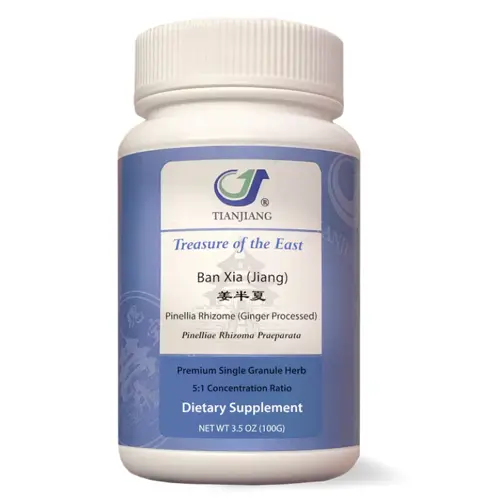
About This Herb*
Traditional Chinese Medicine background and properties
Herb Description*
Ban Xia (pinellia tuber) is one of the most versatile and widely used herbs in Chinese medicine, appearing in hundreds of classical formulas. It is best known for resolving phlegm, stopping nausea and vomiting, and relieving feelings of stuffiness or fullness in the chest and stomach. Because the raw tuber is irritating and mildly toxic, it is always processed before internal use, most commonly with ginger and alum or with licorice and lime.
Herb Category*
Main Actions*
- Dries Dampness and Transforms Phlegm
- Directs Rebellious Qi Downward and Stops Vomiting
- Eliminates Focal Distention
- Reduces Swelling and Alleviates Pain
How These Actions Work*
'Dries dampness and transforms phlegm' (燥湿化痰) is Ban Xia's most important action. In TCM, the Spleen is responsible for transforming fluids, and when it becomes sluggish, dampness accumulates and thickens into phlegm. Ban Xia's acrid, warm, and drying nature directly addresses this dampness at its source. It is considered the single most important herb for treating phlegm caused by dampness, particularly when the phlegm is thin, white, and copious. This is why it features so prominently in foundational phlegm-resolving formulas like Er Chen Tang.
'Descends rebellious Qi and stops vomiting' (降逆止呕) refers to Ban Xia's ability to redirect the Stomach's Qi downward. The Stomach's normal movement is downward; when this reverses, nausea and vomiting result. Ban Xia is regarded as one of the most effective antiemetic herbs in the entire materia medica, and classical texts call it the 'essential herb for stopping vomiting' (止呕要药). It can be used for vomiting from many causes, including Stomach Cold, Stomach Heat, phlegm obstruction, and even pregnancy-related nausea, provided it is combined with appropriate partner herbs.
'Disperses focal distension and dissipates nodules' (消痞散结) means Ban Xia can break up areas of fullness, stuffiness, or lumps caused by phlegm and stagnant Qi binding together. This applies to epigastric stuffiness (as in the pattern called 'heart below stuffiness'), the sensation of a lump stuck in the throat (called 'plum-pit Qi' or mei he qi), and even palpable nodules like goiters or lumps under the skin. Its acrid flavour opens and disperses, while its warm nature promotes movement.
Topical use for swelling: When applied externally in its raw (unprocessed) form, Ban Xia can reduce swelling and relieve pain in conditions like abscesses, carbuncles, and insect bites. The raw form is toxic when taken internally and is reserved for external application only.
Patterns Addressed*
In TCM, symptoms cluster into recognizable patterns of disharmony that reveal what's out of balance in the body. Ban Xia is traditionally associated with these specific patterns.
The following describes this herb's classification within Traditional Chinese Medicine theory and is provided for educational purposes only.
Why Ban Xia addresses this pattern
Ban Xia is the primary herb for phlegm arising from dampness. Its acrid taste disperses and opens, its warm temperature activates the Spleen's transforming function, and its drying nature directly eliminates the dampness that generates phlegm. It enters the Spleen channel (where phlegm is produced) and the Lung channel (where phlegm accumulates), addressing the problem at both its source and its storage site. This makes it the cornerstone of virtually all dampness-phlegm formulas.
A practitioner would look for one or more of these signs
Copious thin white sputum that is easy to expectorate
Stifling sensation in the chest
Nausea with loss of appetite
Dizziness or heaviness of the head
Tiredness with heavy limbs, greasy tongue coating
Why Ban Xia addresses this pattern
When the Stomach Qi fails to descend and instead flows upward (called 'rebellious Qi'), the result is nausea and vomiting. Ban Xia's acrid, warm nature powerfully redirects Qi downward, harmonizing the Stomach and restoring its normal descending function. Classical texts call it the 'essential herb for stopping vomiting.' It is effective for vomiting from cold, heat, phlegm obstruction, or even Qi deficiency when combined with appropriate partners.
A practitioner would look for one or more of these signs
Persistent nausea
Vomiting of watery or phlegmy fluid
Belching and acid reflux
Hiccups or dry retching
Why Ban Xia addresses this pattern
When emotional stress causes the Liver Qi to stagnate, the body's fluid metabolism is disrupted and phlegm forms. This phlegm then binds with the stagnant Qi, creating a tangled obstruction. The hallmark symptom is the feeling of something stuck in the throat that can neither be swallowed nor coughed up (called 'plum-pit Qi'). Ban Xia's acrid dispersing action breaks through the phlegm accumulation, while its descending nature moves the blocked Qi downward, untangling the knot of phlegm and Qi together.
A practitioner would look for one or more of these signs
Sensation of a lump in the throat
Chest and rib-side fullness or oppression
Emotional tension or irritability
Why Ban Xia addresses this pattern
When turbid phlegm ascends and clouds the Heart (the organ of consciousness in TCM), it disrupts the spirit and causes insomnia, mental fogginess, or in severe cases, confusion. Ban Xia's ability to transform phlegm and direct Qi downward helps clear this obstruction. A classical application from the Huang Di Nei Jing pairs Ban Xia with millet (shu mi) specifically to treat insomnia caused by Stomach disharmony preventing the spirit from settling at night.
A practitioner would look for one or more of these signs
Difficulty falling asleep, restless mind
Dizziness with a heavy, foggy head
Palpitations with a sense of phlegm obstruction
TCM Properties*
Warm
Acrid / Pungent (辛 xīn)
Tuber (块茎 kuài jīng / 块根 kuài gēn)
This is partial information on the herb's TCM properties. More detailed information is available on the herb's dedicated page
*These statements have not been evaluated by the Food and Drug Administration. This product is not intended to diagnose, treat, cure, or prevent any disease.